Point of Interest Cinema is a pipeline sample to demonstrate ETL transformation capabilities. It retrieves textual data from a CSV file, transform it (property renaming, string replacement, create new property, ...) and write the result to another CSV file.
¶ Pipeline
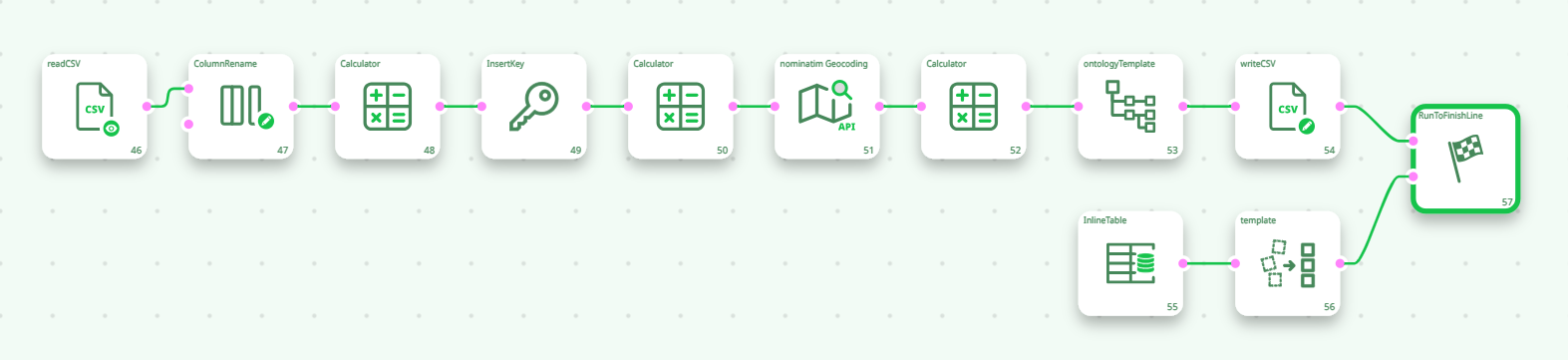
Here is the graph designed for Point of Interest Cinema example;
Now let's examine graph steps and action associated:
- readCSV : first step of the graph. read dataset csv file (cinema.csv) and load data.
- ColumnRename : transform osm_id property name to osmid
- Calculator : transformation to create multiple final properties.
- COORDONNES_GEO : computed property based on latitude (Y) and longitude (Y). The output format of the action representing COORDONNEES_GEO property is "Y_X".
- NAME : generated from the original name property. If a name of the cinema property is empty in original dataset, we fill the property with the simple "cinema" word.
- MARQUE : string replacement in marque property.
- OPENING_HOURS : string replacement in opening_hours property.
- URL : construct a variable containing the url of the web service used to make some reverse geocoding. In our case we use a local geocoding service and the url variable has the value "http://ip:8080/reverse?format=json&lon="//X//"&lat="//Y". Note that we use that variable X and Y which represent Latitude and Longitude in original dataset are used as parameter to get the address of the cinema.
- MOTS_CLES : create this property and fill it with 'cinema' and 'cinéma' keywords.
- InsertKey : to generate CINEMA_ID property. this id allow to identify each cinema but is not present in original dataset. we need to generate one based on a simple incremental value from 1 to the number of records.
- Calculator : this processing step is used to assign marking to records.
- nominatimGeocoding : call nominatim reverse geocoding service. Pass X and Y hase parameters and extract from json result
- Calculator : create adress_name property. Concatenate num and street values from nominatim output and fill adress_name with this concatenate string.
- ontology-poi : define ontology mapping. Map original dataset properties (ref_cnc, marque), temporary variable () and computed variable (COORDONNEES) to properties in the final ontology.
- writeCSV : genereate the output csv file from ontology-poi output.
- InlineTable : declare two variable; C1 containing poi-cinema.csv (graph output file), C2 containing POI-CINEMA (ontology name) and pass it to the next action.
- ingestAndStoreFiles : use previously defined variables C1 and C2 as input parameter of this action to upload the poi-cinema.csv output file and assign it to the ontology name defined in C2 (POI-CINEMA).
- RunToFinishLine : dedicated action used to finalize a graph.