¶ Description
Generate a GLM Tree model.
¶ Parameters
¶ Parameters tab
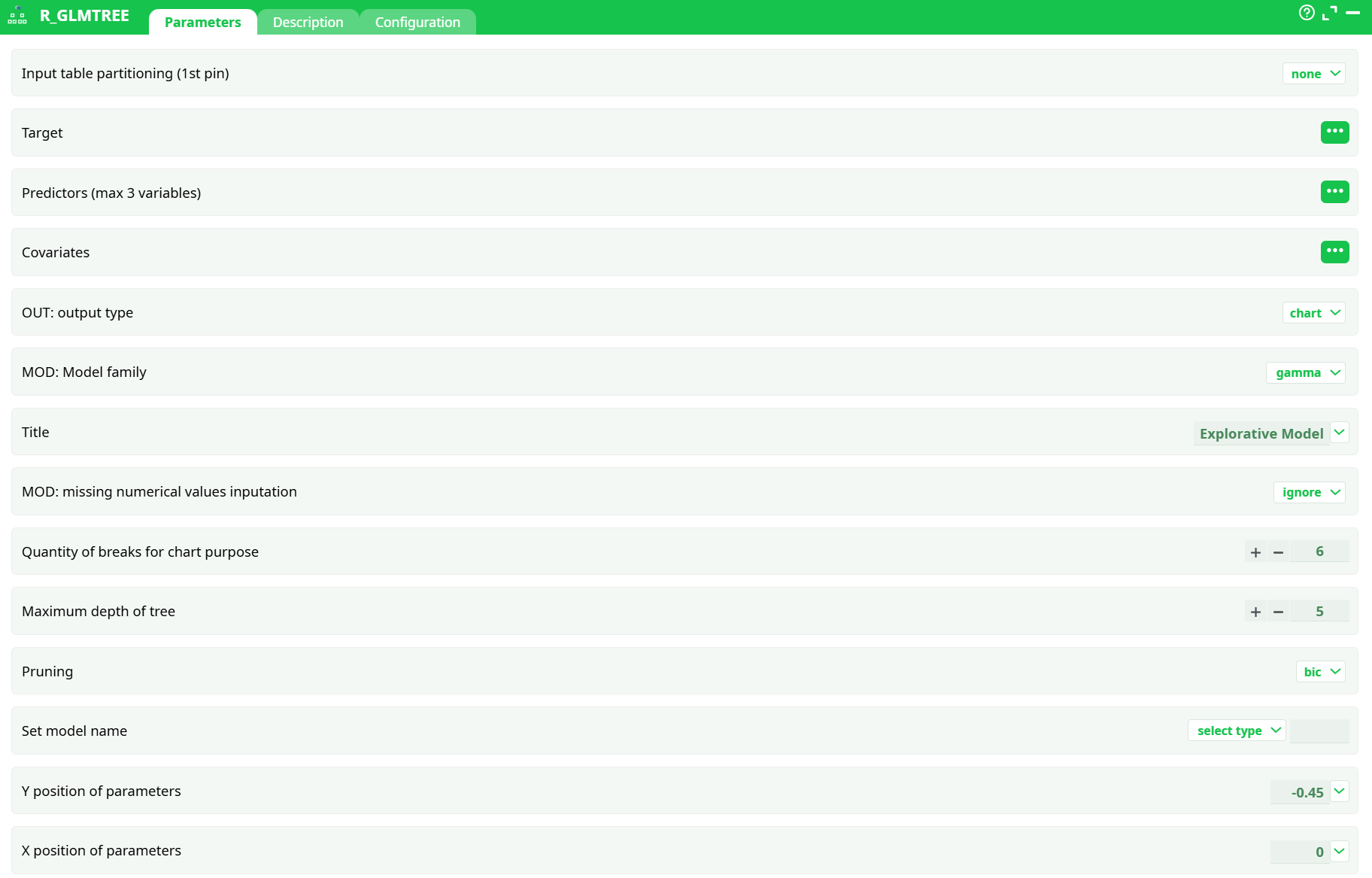
Parameters:
- Target
- Predictors (max 3 variables)
- Covariates
- Out: output type
- Model family
- Title
- Mod: numerical missing values inputation
- Quantity of breaks for chart purpose
- Maximum depth of tree
- Pruning
- Set model name
- A short description
- A short description
- Y position of parameters
- X position of parameters
¶ Description tab
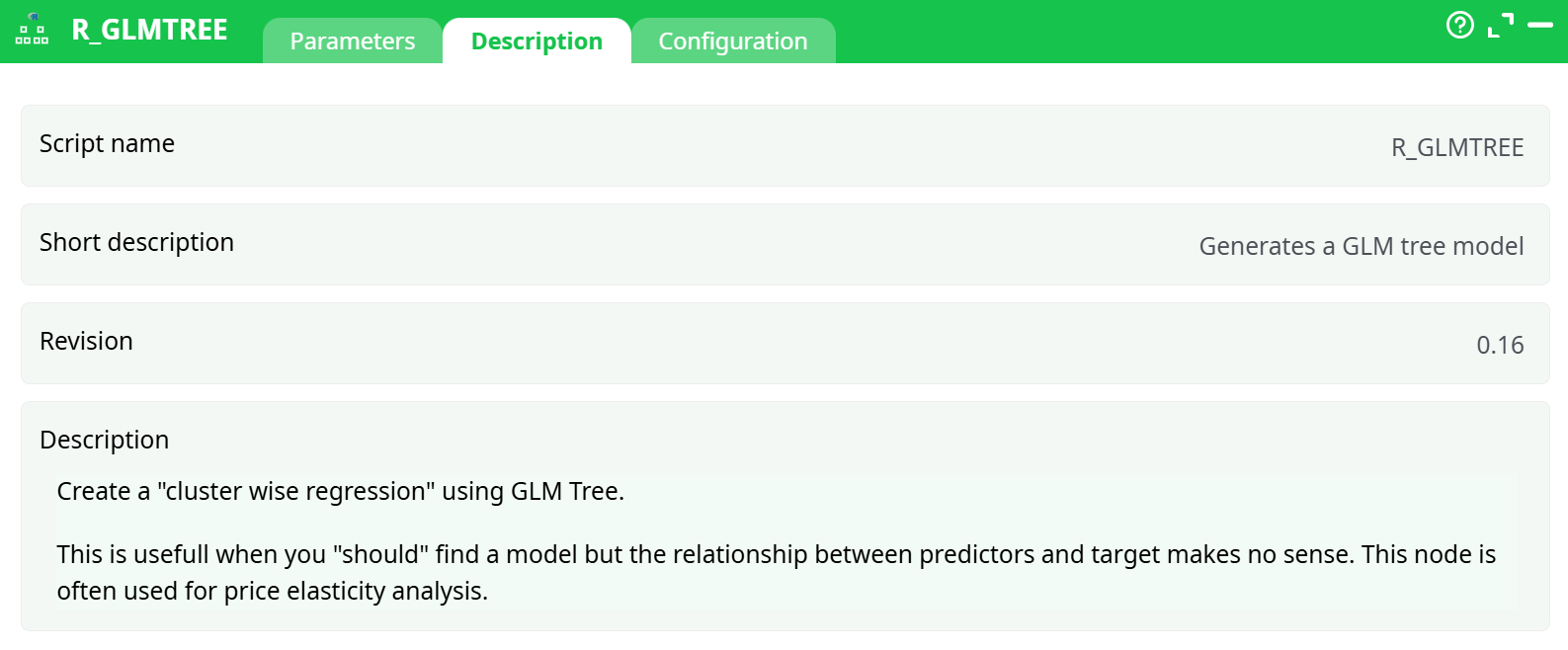
Parameters:
- Script name
- Short description
- Revision
- Decription
¶ Configuration tab
See dedicated page for more information.
¶ About
Apply cluster-wise generalized linear models (GLM Trees) to discover segments where a different GLM best explains the target. The node jointly learns:
- a partitioning tree based on one or more covariates, and
- a GLM (with chosen family) inside each terminal node using the selected predictors.
It’s ideal when a single global regression under-fits because relationships vary across sub-populations (e.g., price elasticity differs by visit intensity).
¶ What you feed in
A single table with at least these columns:
- Target (numeric for
gaussian, strictly positive forgamma, etc.) - Predictors (up to 3 numeric columns fitted in each GLM)
- Covariates (one or more numeric columns used only for splitting the tree; not necessarily in the GLM)
- Optional: any additional columns (ignored)
¶ Example schema
| Column | Role | Notes |
|---|---|---|
Sales |
Target | numeric (continuous) |
Price |
Predictor | numeric |
Promo |
Predictor | 0/1 or numeric |
Visits |
Covariate | numeric; used for splits |
¶ Typical workflow
- Read data → (optional) clean/impute/scale → R_GLMTree → RunToFinishLine
- Optionally switch output to a model file and apply later with your apply-model node.
¶ Key parameters (with plain-English meanings)
| Section / ID | What it means | Typical setting |
|---|---|---|
| Target | Column to predict | Sales |
| Predictors (max 3) | Columns inside the GLM | Price, Promo (or up to 3) |
| Covariates | Columns that split the tree (segment drivers) | Visits (can be multiple) |
| OUT: output type | What to emit | chart (HTML report) during exploration; model to export a model |
| MOD: Model family | GLM family inside each leaf | gaussian (continuous); gamma (positive, skewed); others as provided |
| Title | Title on charts/reports | e.g., Explorative Model |
| Missing values | NA handling for numerics | replace by mean is a practical default |
| Quantity of breaks | Max candidate split points (coarsening) | 6 (balanced speed/quality) |
| Maximum depth | Max tree depth (number of splits) | 5 for moderate complexity |
| Pruning | Complexity criterion | bic (parsimonious) |
| Set model name | Path when OUT = model |
e.g., records/glmtree_sales.rModel |
Notes
- Predictors and covariates may overlap, but they do not need to.
- For
gammafamily: target values must be strictly positive.- Categorical predictors should be pre-encoded (e.g., 0/1 dummies).
¶ What comes out
Depending on OUT: output type:
-
chart/HTML document- Visual summary: tree diagram, per-segment GLM summaries (coefficients, standard errors, deviance), and fit diagnostics.
-
model- A serialized model object (e.g.,
records/glmtree_sales.rModel) you can reuse for scoring with the appropriate Apply Model action button.
- A serialized model object (e.g.,
¶ How the model is built (conceptual)
- Start with all rows.
- Fit a GLM with chosen family on the predictors.
- Evaluate covariate-dependent instability tests to find a split that most improves the GLM fit.
- Split the data, refit GLMs in each child node, and repeat until maximum depth or pruning criterion stops further splitting.
- If pruning is active (e.g., BIC), sub-trees that don’t justify their complexity are collapsed.
With the table shaped as described and the parameters set via the column pickers, this node will build a segmented regression that uncovers distinct response behavior across covariate-defined groups—often the clearest way to surface varying elasticities or campaign effects in a single, interpretable model.